8 Best Document Scanners for Windows PCs (November 2026)
The best document scanners for Windows PCs include the Epson Workforce ES-590W Wireless & USB High-Speed for busy Windows offices, the Epson Workforce ES-50 Compact & Lightweight Mobile for portable Windows scanning, and the Brother DS-640 Compact Mobile Document Scanner for mobile card scanning.
On this page (5 sections)
The best document scanner for PC users is the Epson Workforce ES-590W, with Wi-Fi, USB, duplex scanning, a 100-page feeder and speeds up to 45 ppm.
That combination removes two common delays in daily scanning. You do not have to reload a small feeder every few pages, and you do not have to flip a sheet over to capture the back.
Choose a portable Epson or Brother for mobile work, or a Canon for simple office scanning. Those choices solve a different problem, not a lesser one.
A Windows workflow can need very different hardware. A small business may scan contracts and invoices in batches, while a traveling user may only need receipts, cards or one-page forms.
A home office user may sit between those extremes. That user scans often enough to want speed, but also wants a machine that does not take over the desk.
We compared listed features, connections, feeder sizes and Windows support. We looked at speed, but we did not stop at speed.
We looked at how pages enter the scanner and whether both sides are captured in one pass. We looked at whether the connection fits the computer you already own.
We also looked at size and weight, because a scanner that cannot move easily will stay in one place. Our score weighs specs, features and buyer feedback against what you are shopping for.
That means a high score for a desktop model does not make it right for travel. A high score for a portable model does not make it right for a stack of records.
Decide how you will actually use the scanner before you compare prices or rankings. Think about your normal week instead of your best week.
Count the pages you handle on a busy day. Note whether they are single sided or double sided, and whether they include cards, receipts or long pages.
That simple check will narrow the list faster than any headline speed claim. For a broader overview of scanner types, use our guide to a digital scanner for documents.
If you also use Apple hardware, compare these best document scanners for Mac. Use those guides for context, then return here to match the hardware to your Windows setup.
The sections below explain the trade off between batch capacity, portability and connection options in plain terms, so you can judge each model against the pages you actually scan.
Our picks at a glance
-
1
 Best for busy Windows offices
Epson Workforce ES-590W Wireless & USB High-Speed
9.7/10 our score
See it on Amazon -
2
 Best for portable Windows scanning
Epson Workforce ES-50 Compact & Lightweight Mobile
9.6/10 our score
See it on Amazon -
3
 Best for mobile card scanning
Brother DS-640 Compact Mobile Document Scanner
9.5/10 our score
See it on Amazon
- 4
 Check it
ScanSnap iX2500 Wireless or USB High-Speed Document
Best for connected document libraries - 5
 Check it
Epson Workforce ES-400 II High-Speed Color Duplex
Best for USB office batches - 6
 Check it
HP Small USB Document & Photo Scanner
Best for light portable scanning - 7
 Check it
Canon imageFORMULA R50 Business Document Scanner
Best for shared wireless scanning - 8
 Best for plug-and-scan setupCheck it
Which document scanner is best for a Windows PC?
The Epson Workforce ES-590W is the best overall document scanner for a Windows PC because it combines a 100-page feeder, 45 ppm duplex scanning, Wi-Fi, USB and a large touchscreen.
Its desktop design fits users who scan paperwork often and want more than a single-sheet device.
The ScanSnap iX2500 is close behind for buyers who want a 100-sheet feeder, Wi-Fi 6, USB-C and compatibility across Windows, Mac, mobile devices and ChromeOS. The Epson ES-400 II uses USB and a 50-sheet feeder, but it still suits many home and office batches.
The difference between those top choices comes down to how much you value wireless flexibility. The ES-590W and the iX2500 both support large batches without constant reloading.
That matters when a job includes invoices, contracts or client files that run to many pages. A smaller feeder can still work well for a home office, but it asks you to stop and add paper more often.
For a single user with a fixed desk, USB can be the simplest connection. You plug the cable in, the computer sees the device, and the workflow stays direct.
Wi-Fi becomes more useful when the scanner needs to sit away from the desk. It also helps when more than one person needs to send a scan.
The touchscreen on the leading desktop models changes the routine in a practical way. You can choose a destination at the scanner instead of returning to the computer for each step.
That is useful for email, cloud storage or a connected drive. It is less useful if you always preview and edit on the computer anyway.
The ScanSnap iX2500 also suits buyers who move between several kinds of devices. Its listed compatibility covers Windows, Mac, iOS, Android and ChromeOS, which helps in a shared home or a small office with mixed hardware.
The ES-590W is aimed more clearly at a Windows desktop workflow. Its 600 dpi resolution and 30-bit input color depth support detailed document capture.
Its weight also tells you where it belongs. At 8.2 lb, it is a permanent desk tool rather than a travel tool.
That is not a flaw if your scanning happens in one place. It becomes a flaw only if you expected to carry it to another room or a client site.
The ES-400 II sits in the middle of the range. It offers duplex scanning and a 50-sheet feeder without wireless connection.
That makes it a sensible pick for a single Windows PC on a desk. You trade some convenience for a simpler setup, which is easy to accept for regular home and office batches.
How we chose the best document scanners for PC use
We prioritized features that affect daily Windows scanning: connection type, sheet capacity, duplex capture, speed, OCR and the space needed on a desk.
We also separated portable single-sheet scanners from desktop models because they solve different problems.
A portable model wins on space, weight and setup with a laptop.
A desktop model wins when you need to leave a stack to feed on its own.
A USB connection gives a direct link to a Windows computer.
That direct link is simple to understand and simple to maintain.
It also avoids questions about network settings or wireless passwords.
Wi-Fi adds placement and shared-use flexibility, while a touchscreen can reduce the number of computer steps for common scan destinations.
Those benefits are real, but they only help if your room layout or team workflow needs them.
A duplex scanner captures both sides of a sheet in one pass.
That matters for contracts, forms and records printed on both sides, but it is less important if you scan mostly single-sided receipts.
Duplex capture also reduces the chance that a back page is missed.
It does not remove the need to check the output when pages are thin or fragile.
OCR turns scanned pages into searchable or editable files when the software supports it.
The Epson ES-50, Epson ES-400 II and Brother DS-640 specifically include OCR-related workflows, while the other models include their own document organization or embedded scanning features.
Searchable text helps when you need to find a name, date or amount later.
Editable files help when you need to reuse text in a document or spreadsheet.
The best computer scanner for documents also needs a feeding method that fits your volume.
A 100-sheet feeder is useful for a large stack, while a compact single-sheet model is easier to carry and store.
Feeder size should match your largest normal batch, not your largest possible batch.
If most jobs run to ten pages, a very large feeder adds bulk without daily benefit.
If most jobs run to fifty pages or more, a small feeder will slow you down.
| Product | Best for | Connection | Feeder | Duplex speed | Our score |
|---|---|---|---|---|---|
| Epson Workforce ES-590W Wireless & USB High-Speed | busy Windows offices | USB and Wi-Fi | 100 sheets | Up to 45 ppm | 9.7 |
| Epson Workforce ES-50 Compact & Lightweight Mobile | portable Windows scanning | USB 2.0 | 1 sheet | 9.6 | |
| Brother DS-640 Compact Mobile Document Scanner | mobile card scanning | USB | 1 sheet | 9.5 | |
| ScanSnap iX2500 Wireless or USB High-Speed Document | connected document libraries | USB and Wi-Fi | 100 sheets | 9.4 | |
| Epson Workforce ES-400 II High-Speed Color Duplex | USB office batches | USB | 50 sheets | 9.2 | |
| HP Small USB Document & Photo Scanner | light portable scanning | USB | 8.7 | ||
| Canon imageFORMULA R50 Business Document Scanner | shared wireless scanning | USB and Wi-Fi | 60 sheets | 8.5 | |
| Canon imageFORMULA R30 | plug-and-scan setup | USB | 60 sheets | 8.1 |
The best document scanner for PC workflows
The top desktop picks focus on feeder capacity, fast duplex scanning and easier connections. The portable models trade batch speed for a smaller body and USB power.
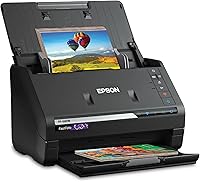
Epson Workforce ES-590W Wireless & USB High-Speed: Best for busy Windows offices
- Up to 45 ppm
- 100-page automatic document feeder
- Wi-Fi and USB
- 4.3-inch color touchscreen
The ES-590W combines a large feeder, fast double-sided scanning, Wi-Fi and a color touchscreen for regular desktop workflows.
Pros
- Largest feeder here
- Wireless scanning
- Computer-free touchscreen workflows
Cons
- Heavier than the portable models
- Designed for a permanent desk setup
The Epson Workforce ES-590W is the strongest all-around choice for a busy Windows desk. It scans both sides in a single pass at up to 45 ppm, and its 100-page automatic document feeder gives you room for larger paperwork batches.
Wi-Fi and USB cover the two most common PC setups. Wi-Fi lets you place the scanner where it works best in the room, while USB keeps the connection direct.
The large 4.3-inch color touchscreen supports ScanWay computer-free workflows. You can send scans to email accounts, cloud storage or a connected USB flash drive from the scanner itself.
Epson ScanSmart AI technology is designed to convert scans into AI-ready data. The scanner also supports 600 dpi resolution, has a 30-bit input and 24-bit output color depth, and weighs 8.2 lb.
Choose it for a regular Windows office workflow with large stacks and frequent double-sided pages. Its 6.7 x 11.6 x 6.6 in body is better suited to a permanent workspace than a travel bag.
Epson Workforce ES-50 Compact & Lightweight Mobile: Best for portable Windows scanning
- Single-sheet scanning
- USB powered
- Windows and Mac compatible
- Nuance OCR included
The ES-50 is a lightweight single-sheet scanner for receipts, ID cards, long pages and small mobile workflows.
Pros
- 9.44 oz weight
- No external power supply
- Creates searchable PDFs and editable files
Cons
- Single-sheet feeding
- USB connection only
The Epson Workforce ES-50 is the best fit when a Windows laptop travels with you. It weighs 9.44 oz, measures 10.7 x 10.7 x 1.3 in, and draws power through USB 2.0, so it doesn't need batteries or a separate power supply.
This is a single-sheet scanner, not a high-volume desktop feeder. Epson says it can scan one page in as fast as 5.5 seconds and can accept documents up to 8.5 x 72 in.
Receipts and ID cards also fit the use case. Automatic Feeding Mode combines sheets into one file as you insert them, which helps with a small multi-page job without adding a full desktop scanner.
Nuance OCR can create searchable PDFs and editable Word and Excel files. The included Epson ScanSmart software supports Windows and Mac, and a TWAIN driver works with imaging software.
Pick it for mobile paperwork, receipts and occasional forms. If you regularly scan a stack without hand-feeding each page, choose a desktop model instead.
Brother DS-640 Compact Mobile Document Scanner: Best for mobile card scanning
- Up to 16 ppm
- Micro USB 3.0 power
- Windows, Mac and Linux support
- Business card and plastic card support
The DS-640 is a compact USB scanner that handles documents, receipts, business cards and plastic ID cards in a mobile setup.
Pros
- Supports Windows, Mac and Linux
- Color and black-and-white scanning at the same speed
- Portable 1 lb design
Cons
- Single-sheet feeding
- No wireless connection
The Brother DS-640 is a compact mobile document scanner for Windows users who also need Mac or Linux support. It scans color and black-and-white pages at up to 16 ppm, with the same stated speed for both modes.
The scanner weighs 1 lb and measures 1.99 x 11.9 x 1.45 in. Its included micro USB 3.0 cable powers it from a PC or laptop, which is useful when an outlet isn't nearby.
It handles business cards, embossed cards, ID cards, laminated cards, plain paper and receipts. The 300 dpi scanner uses a single-sheet path, so it is best for small jobs rather than unattended stacks.
Brother's software supports scan-to destinations such as PC, network, cloud services, email and OCR. Image tools include automatic color adjustment, background removal, text enhancement and bleed-through prevention.
Choose it when card handling and broad operating-system support matter. For a faster Windows-only desktop workflow, the Epson ES-590W or Canon R50 is a better match.
ScanSnap iX2500 Wireless or USB High-Speed Document: Best for connected document libraries
- 45 ppm double-sided scanning
- 100-sheet feeder
- Wi-Fi 6 and USB-C
- Large touchscreen
The iX2500 pairs a 100-sheet feeder and fast duplex scanning with touchscreen profiles, Wi-Fi 6, USB-C and cloud workflows.
Pros
- High-capacity feeder
- Wide device compatibility
- Brake roller and multi-feed detection
Cons
- Desktop size
- More capability than occasional users may need
The ScanSnap iX2500 is a strong choice for a shared document library. It scans double-sided pages at up to 45 ppm, holds up to 100 sheets and connects by Wi-Fi 6 or USB-C.
Its large touchscreen supports personalized profiles, so different users can select their own scan destinations. The scanner works with Windows, Mac, iOS, Android and ChromeOS, which helps when documents move between several devices.
ScanSnap Cloud supports scanning directly to a cloud service without a computer. The system can automatically make text searchable, optimize files, name them and sort them into folders and clouds.
A brake roller helps feed paper smoothly. The multi-feed sensor detects pages stuck together, and skew detection is designed to help prevent paper damage and data loss.
At 7.7 lb and 6.26 x 11.5 x 6.34 in, it belongs on a desk. Choose it for a connected home office or shared workspace that needs profiles and cloud organization.
Epson Workforce ES-400 II High-Speed Color Duplex: Best for USB office batches
- Up to 35 ppm
- 50-sheet automatic document feeder
- Color duplex scanning
- OCR and TWAIN driver
The ES-400 II is a USB desktop scanner for home and office batches, with duplex capture, OCR, cloud sharing and image adjustments.
Pros
- 50-sheet feeder
- Duplex scanning
- Double-feed detection
Cons
- USB only
- Slower than the 45 ppm desktop picks
The Epson Workforce ES-400 II is a practical USB desktop scanner for home and office batches. Its 50-sheet automatic document feeder and duplex capture let you process both sides of a stack without using a flatbed.
It scans up to 35 ppm based on letter-sized scans at 300 dpi. Epson ScanSmart software supports previewing, emailing and cloud uploads, while automatic file naming can reduce routine sorting work.
The included TWAIN driver helps it fit into document management software. OCR can create searchable PDFs and convert scans to editable Word or Excel files.
Image tools include auto crop, blank-page removal, background removal, dirt detection and paper-skew correction. Ultrasonic double-feed detection helps identify pages that move through together.
The ES-400 II is PC and Mac compatible but uses USB rather than Wi-Fi. Choose it when a direct desktop connection is enough and your batches are smaller than the 100-sheet models support.
HP Small USB Document & Photo Scanner: Best for light portable scanning
- 15 ppm simplex scanning
- USB powered
- Windows and Mac software
- Document and photo support
The HPPS100 is a very light USB scanner for occasional documents, photos, receipts, cards and small batches.
Pros
- 3 oz weight
- Windows and Mac compatible
- 10-sheet standard capacity
Cons
- One-sided scanning
- USB connection only
The HPPS100 is the lightest option here for occasional scanning. It weighs 3 oz, measures 2 x 11.6 x 1.4 in and connects through USB 2.0 with the cable included.
It uses one-sided sheetfed scanning at 15 ppm, or about 4 seconds per page. The scanner supports documents from 2 x 2.9 in up to 8.5 x 14 in, along with business cards, photos, receipts and other small media.
HP WorkScan software for Windows and Mac includes auto-scan and size detection. It also offers previewing, zooming, cropping, editing and background cleanup.
The standard sheet capacity is 10, which makes it more suitable for light batches than a busy records workflow. It also has a 300 dpi resolution rather than the higher resolution listed for some other models here.
Choose it for a bag, briefcase or small home workspace. For two-sided office records, select a duplex desktop scanner instead.
Canon imageFORMULA R50 Business Document Scanner: Best for shared wireless scanning
- Up to 40 ppm
- 60-sheet automatic feeder
- Wi-Fi and USB
- 4.3-inch color touchscreen
The Canon R50 supports shared desktop workflows with Wi-Fi, USB, a touchscreen, duplex scanning and a 60-sheet feeder.
Pros
- Wireless and USB options
- 40 ppm color duplex scanning
- Handles cards and mixed documents
Cons
- Larger desktop footprint
- Windows minimum requirements begin at Windows 7
The Canon imageFORMULA R50 suits a Windows or Mac office that needs wireless sharing. It combines Wi-Fi and USB, a 4.3-inch color touchscreen, a 60-sheet feeder and color duplex scanning up to 40 ppm.
The touchscreen lets you select scan destinations, shortcuts and device settings. That can make recurring office tasks easier for users who don't want to start every scan from a computer.
Canon says the R50 handles receipts, plastic cards, contracts and thick, thin or long documents, either individually or in batches. Its 600 resolution and automatic output adjustment support mixed document work.
The scanner measures 9.8 x 11.5 x 9.5 in and weighs 7.4 lb. It is a full desktop unit, so measure the available depth and height before setting it beside a monitor.
Pick it when Wi-Fi, touchscreen controls and a 60-sheet feeder are more useful than the larger capacities of the top two models. For more card-specific comparisons, see our guide to the best scanners for documents and cards.
Canon imageFORMULA R30: Best for plug-and-scan setup
- Up to 25 ppm
- 60-sheet automatic feeder
- Duplex scanning
- Embedded software
The Canon R30 keeps setup simple with USB connection, embedded software, duplex scanning and a 60-sheet feeder.
Pros
- No software installation required
- Duplex scanning
- Handles mixed document batches
Cons
- USB only
- TWAIN and ISIS drivers are not supported
The Canon imageFORMULA R30 is the simplest desktop scanner in this group. Its embedded software means you can connect it with the supplied USB cable without installing separate scanning software.
It captures both sides at once at up to 25 ppm and holds up to 60 sheets in its automatic feeder. Canon says it handles documents, invoices, contracts and business cards, including mixed batches.
The R30 measures 9.88 x 11.54 x 9.65 in and weighs 6.6 lb. It uses a USB connection and supports Windows 7 as a minimum system requirement.
The main limitation is software support. TWAIN and ISIS drivers are not supported, so check that your intended Windows workflow works with the device's embedded software before choosing it.
Choose the R30 when plug-and-scan simplicity matters more than wireless access or third-party driver support. For setup ideas, read how to use a Canon document scanner.
How to choose a document scanner for a computer
Choose a desktop scanner when you regularly process multi-page paperwork, and choose a portable scanner when you carry the device or scan only a few sheets at a time. The right document scanner for computer use depends on volume, paper type and the connection your Windows setup allows.
Do you need duplex scanning?
Choose duplex scanning for contracts, forms and records printed on both sides. The ES-590W, ScanSnap iX2500, ES-400 II, Canon R50 and Canon R30 capture both sides in one pass.
A one-sided scanner can still be the better choice for receipts and single-page forms. The HPPS100 is built around that lighter workflow, while the Epson ES-50 and Brother DS-640 use single-sheet feeding for portable scanning.
Is USB or Wi-Fi better for Windows?
USB is the direct choice for one Windows PC. Wi-Fi is more useful when the scanner sits away from the computer or several people need access.
The Epson ES-590W, ScanSnap iX2500 and Canon R50 offer both USB and wireless connections. The Epson ES-50, Brother DS-640, Epson ES-400 II, HPPS100 and Canon R30 use USB.
How much feeder capacity do you need?
A 100-sheet feeder is the best match for larger batches, while 50 or 60 sheets can cover regular home-office work. Single-sheet scanners require you to feed pages one at a time, even when their software can combine them into one file.
The ES-590W and ScanSnap iX2500 hold 100 sheets. The ES-400 II holds 50, and the Canon R50 and R30 hold 60.
The portable Epson and Brother models have a 1-sheet capacity, while the HPPS100 lists 10 sheets.
What should you scan first?
Separate receipts, cards, photographs and long pages before starting a batch. Remove clips and staples, keep pages aligned, and use the scanner's image tools or OCR when the final file needs to be searchable.
For a high-volume workflow, load only the paper the feeder is designed to handle. For a portable scanner, keep the cable with the device and feed each page straight to reduce skew.
What is the best document scanner for PC buyers?
Pick the Epson Workforce ES-590W for the most complete Windows desktop setup, especially if you need a 100-page feeder, Wi-Fi, USB and fast duplex scanning.
Pick the Epson ES-50 for a lightweight laptop workflow, or the Brother DS-640 when card support and Linux compatibility matter. Choose the ScanSnap iX2500 for connected profiles and cloud organization.
The Epson ES-400 II is a strong USB office option, while the Canon R50 adds wireless sharing and the Canon R30 keeps setup simple.
Those short picks hide an important point about daily use. The right scanner is the one you will use without friction.
A fast desktop model is only fast if it stays connected and ready. A portable model is only useful if it fits your bag and your cable stays with it.
Check the connection first because it shapes every scan that follows. USB suits one computer at one desk with a short cable run.
Wi-Fi suits a scanner placed across the room or shared by a small team. Check the feeder next because it shapes how often you must stop.
A 100-sheet feeder suits large office batches. A 50 or 60-sheet feeder suits regular home office work, and a single sheet path suits receipts, cards and occasional forms.
Check duplex capture next because it shapes how you handle double sided paper. Duplex scanning is valuable for contracts and records.
It is less valuable for photos, receipts and single page letters. Check the paper types you scan most often.
Cards need a path that can accept them without damage. Long pages need a scanner that lists that length in its specifications.
Mixed batches need a feeder and software that can sort the result in a sensible way. Check size and weight before you order.
A desktop scanner needs clear space for the body, the feeder and the output path. A portable scanner needs space in a bag and a laptop port that can power it.
Check the software list before you order as well. You need to know how files are named, saved and sent.
You need to know whether searchable PDFs or editable files are included. You need to know whether a TWAIN driver is supported if your Windows app expects one.
The Canon R30 is a clear example of why that check matters. It keeps setup simple with embedded software, but it does not support TWAIN or ISIS drivers.
That limit may not matter to you at all. It may matter a great deal if your office software relies on those drivers.
For wireless alternatives, compare our guide to the best wireless document scanners, and check document scanner deals before ordering.
Match the feeder size to your largest normal batch and confirm that the connection and software fit your Windows computer. That final check will give you a scanner that fits your routine instead of a scanner that only looks strong on a spec sheet.
Our top 3 picks at a glance
-
1
Best for busy Windows offices
Epson Workforce ES-590W Wireless & USB High-Speed
9.7/10 our score
See it on Amazon -
2
Best for portable Windows scanning
Epson Workforce ES-50 Compact & Lightweight Mobile
9.6/10 our score
See it on Amazon -
3
Best for mobile card scanning
Brother DS-640 Compact Mobile Document Scanner
9.5/10 our score
See it on Amazon
Frequently asked questions
What is the best document scanner for a Windows PC?
The Epson Workforce ES-590W is the strongest choice for most Windows desktop users because it combines USB and Wi-Fi, a 100-page feeder, a 4.3-inch color touchscreen and duplex scanning up to 45 ppm. Choose a portable Epson ES-50 or Brother DS-640 when desk space and mobility matter more.
Is a document scanner better than a printer scanner for a PC?
A dedicated document scanner is usually better for repeated paperwork because sheet-fed models can process multiple pages and many capture both sides in one pass. A printer scanner may suit occasional flat documents, but it may not offer the same feeder capacity or document workflow.
What should I look for in a computer scanner for documents?
Match the feeder and scanning method to your workload. Look for a 50- or 100-sheet feeder and duplex scanning for office batches, USB or Wi-Fi for the connection you need, and OCR when you want searchable PDFs or editable Word and Excel files.
Are portable document scanners good for Windows laptops?
Yes. The Epson ES-50 and Brother DS-640 connect by USB and are designed for single-sheet scanning from a computer.
They suit receipts, cards and small jobs, but desktop scanners are a better fit when you regularly scan large stacks.