Brother MFC-L6810DW vs MFC-L5915DW: Which Fits Your Office? (November 2026)
Choose the MFC-L6810DW when its documented paper capacity, print speed and scanning details match your office needs. The MFC-L5915DW may suit you better if its workflow fits, but confirm its specifications before deciding.
On this page (8 sections)
- Which Brother printer fits a busy office?
- How much paper capacity does the office need?
- Which model better handles scanning and copying?
- What do security and connectivity add?
- Which toner choice fits each printer?
- Is the MFC-L6810DW too large for your office?
- Does the L5915DW print in color?
- How should you choose between the two?
Choose the MFC-L6810DW when its documented capacity, speed and scanning workflow suit your office. The MFC-L5915DW may fit better if its specifications meet your needs, but compare the exact models before deciding.
The MFC-L6810DW is a monochrome laser all-in-one with print and copy speeds up to 52 pages per minute. It also has a 520-sheet tray and a 100-sheet multipurpose tray for regular paper and other media.
It has an 80-page automatic document feeder for two-sided scanning. That detail matters if staff regularly scan multipage documents rather than single pages.
That gives you useful decision points for a busy office. Speed, paper input and scanning capacity can shape daily work more than a model name alone.
The available details here do not provide a complete specification comparison for the MFC-L5915DW. You should not assume it matches or falls short on a feature without checking its model information.
Check paper capacity, print speed, feeder size and scanning options for the L5915DW. Then compare each item against the workload your office actually handles.
A shared printer needs to keep moving through long jobs. A larger tray can mean fewer refills during a busy day.
A faster rated speed can help when several people need output at once. It does not remove the need to estimate your normal monthly volume.
Scanning capacity matters when documents arrive in batches. An 80-page feeder can reduce repeated loading for longer sets of pages.
Two-sided scanning can also save time for double sided originals. That may suit offices that scan contracts, forms and reports as a routine task.
The multipurpose tray adds flexibility for custom media or envelopes. It gives you a separate place to load work that does not fit the main tray.
Monochrome output suits text heavy offices that mainly print forms and internal documents. It is less suited to work that depends on color graphics.
Choose based on documented features rather than similar names. The right fit is the model whose stated capacity and workflow match your team.
 Best for predictable toner choice
Brother Genuine Cartridge TN920XXL Super High Yield
 Best for larger workgroups
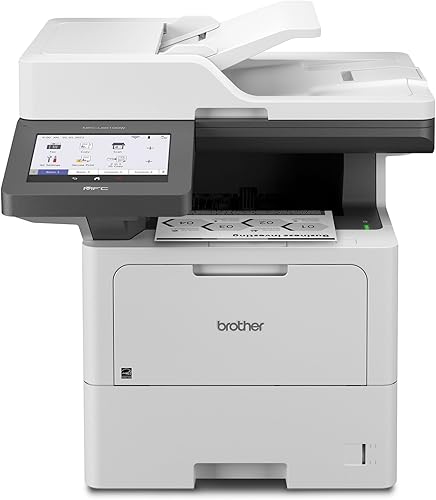
Brother MFC-L6810DW Enterprise Monochrome Laser All-in-One Printer
Which Brother printer fits a busy office?
The MFC-L6810DW has documented capacity and speed for a larger workgroup. It is designed as an enterprise monochrome all-in-one, with features that can reduce paper refills and keep shared print, copy and scan tasks moving.
Its print and copy speeds are up to 52 pages per minute. Actual output depends on the job and setup, so treat that figure as a model specification rather than a promise for every document.
The 520-sheet paper tray and 100-sheet multipurpose tray provide 620 sheets of input capacity before optional trays. The multipurpose tray is intended for custom media or envelopes, while the main tray holds regular office paper.
For a broader look at models for shared work, see our guide to the best laser printer for office use. If you run a smaller team, our best laser printer for small business guide can help frame the choice around scale and daily use.
When does the MFC-L6810DW make sense?
Choose it when several people print and copy often, or when one device needs to handle scanning as well. Its combination of high print speed, a two-tray input setup and a large document feeder points to a workflow with frequent multi-page jobs.
The included toner is described as an 8,000-page cartridge. For replacement, Brother lists the TN920UXXL at 18,000 pages, while the genuine TN920XXL option here is rated for up to 11,000 pages.
A printer's rated speed and cartridge yield help you estimate fit, but they don't tell you how much your office will print. Consider your normal monthly volume, the length of your documents and how often staff need to scan or copy.
What should you verify about the MFC-L5915DW?
Check its own paper capacity, print speed, feeder size and security details before comparing it with the L6810DW. Those are the features that will affect daily office use most.
Don't infer that a similar model name means identical specifications. Use the MFC-L5915DW's model documentation to confirm the tray arrangement, supported paper sizes, network options and included supplies.
If you already own or are considering the L5915DW, its scanning steps are covered in our Brother MFC-L5915DW scan guide. That guide is a useful next read when scan destinations and document handling matter more than print speed.
How much paper capacity does the office need?
Choose capacity based on how often your team can refill trays and the paper types it uses. The L6810DW starts with 620 sheets of input capacity across its main and multipurpose trays.
Its total paper capacity can expand to 1,660 sheets with optional trays. Expansion can be useful when a shared printer serves a large workgroup, but it adds equipment and takes up more room.
A smaller office with modest print volume may not benefit from extra trays. Before prioritizing capacity, estimate how quickly your team uses a ream and whether refills interrupt work.
The 250-sheet output capacity also matters if jobs are long or several people collect printouts at once. Separate completed pages from the next user's documents to reduce mix-ups at a shared device.
Which model better handles scanning and copying?
The MFC-L6810DW's 80-page feeder is suited to longer document batches. It supports single-pass, two-sided scanning, and the document glass accommodates legal-size documents.
The printer can scan to destinations from its 7-inch touchscreen, including cloud services. That can reduce the need to route every scan through a connected computer, depending on the office's setup.
The available speed details describe two-sided scanning at up to 200 images per minute in the product title, while the description gives up to 100 images per minute. Because those figures conflict, verify the current official specification before relying on a scan-speed estimate.
The description also cites a large document feeder and single-pass duplex scanning. For a workflow built around scanning, compare the L5915DW's feeder capacity and duplex method directly with these details rather than assuming they are the same.
For copying, the L6810DW is rated up to 52 pages per minute, with a maximum of 870 copies per run. A batch that large still needs enough paper and a clear place to collect output.
What do security and connectivity add?
The MFC-L6810DW includes enterprise security features and an integrated NFC card reader. These can matter where an office controls access to shared printers and documents.
The model's description refers to triple-layer security for the network, device and documents in transit. The integrated card reader supports badge authentication, which may help tie access to an office's existing process.
Confirm that the printer's authentication and network features work with your organization's systems before choosing based on them. The L5915DW should be evaluated against the same requirements, using details for that exact model.
The L6810DW supports wireless networking and has Ethernet and USB interfaces. Which connection suits your office depends on how staff connect and the network rules in place.
Which toner choice fits each printer?
The TN920XXL is the genuine option here, while the SUDLTO and Toner Bank packs are compatible alternatives. All 3 options list both the MFC-L6810DW and MFC-L5915DW as compatible.
The Brother genuine TN920XXL is a single black cartridge rated for up to 11,000 pages. Its compatibility list includes both printers, plus several other Brother models in the TN920 family.
The SUDLTO pack includes 4 black compatible cartridges, each with a stated yield of 6,000 pages and a chip installed. The Toner Bank pack includes 2 black compatible cartridges, each with a stated 6,000-page yield and a chip.
These options differ in brand and pack size, not in the printers they claim to fit. Before ordering, confirm the cartridge family and the precise printer model; don't use a cartridge just because its name looks similar.
The L6810DW also works with TN920, TN920XL, TN920V, TN920XL 2PK, TN920XXL and TN920UXXL cartridges. Check the exact cartridge naming when ordering, especially if you plan to use the higher-yield replacement.
Is the MFC-L6810DW too large for your office?
Measure the printer's space and delivery route before choosing it. The L6810DW measures 19.5 inches deep, 19.5 inches wide and 20.4 inches high.
It weighs 43.2 pounds.
Those numbers describe the printer itself, not the working space around it. You need room to stand, reach controls and collect printed pages without crowding the desk.
Leave space for opening trays, loading paper and using the touchscreen. A printer that fits on a shelf may still be awkward if staff cannot reach the paper tray.
Staff also need clear access to the output area. Long jobs can pile up quickly, and a blocked tray can slow the next task.
Consider the door and corridor route before delivery. A unit near 20 inches in width and height needs enough clearance to pass through doorways.
It can handle media up to 8.5 by 14 inches. Check that the paper sizes your office uses fit the device and the selected tray.
Legal size pages are larger than standard letter paper. Confirm which tray or feeder accepts each size before you plan a job around it.
Plan for a stable surface that can support the printer's weight. A sturdy desk or stand is safer than a narrow shelf with limited support.
Weight also affects how you move the printer later. At 43.2 pounds, it is better placed once with help than moved often by one person.
Think about nearby power and network points during setup. The right position should keep cables tidy and leave room for paper storage.
Follow the manual for placement, power and network setup. That helps you confirm clearances, connections and the order in which parts should be installed.
Test the connection with the office devices that need access. Check printing, copying and scanning from the places where staff will actually use them.
Leave room to open panels for toner and routine care. A tight corner can make simple tasks harder, especially when a tray is full.
Also think about noise and foot traffic in the chosen spot. A shared printer works best where people can queue, collect output and move on.
If the room is small, compare the footprint with your available surface first. Extra optional trays can add depth or height, so plan for the full setup.
A little measuring before you buy can prevent a poor fit later. The goal is a printer that staff can reach easily every day.
Does the L5915DW print in color?
The MFC-L5915DW is a monochrome model, so it prints in black rather than color. The MFC-L6810DW is also monochrome.
Both are built for black output.
That shared point simplifies one part of the decision. If color is essential, neither printer in this comparison is the right type of device.
If the office regularly prints color charts, marked-up diagrams or customer-facing graphics, either model may be the wrong fit. Our guide to whether the Brother MFC-L5915DW prints in color explains the distinction and what to consider instead.
Color can carry meaning in charts and diagrams. Black printing may make those pages harder to read or less suitable for clients.
Customer facing documents often need a polished look. A monochrome printer may suit drafts and internal copies better than final handouts.
For text, forms and internal documents, monochrome output may be all the office needs. Separate the decision about color from the comparison of speed, paper capacity and scanning.
Most office paperwork is still black and white. Forms, invoices, letters and records can print clearly without color.
That can keep the choice focused on daily workflow. You can then weigh speed, tray capacity, scanning and placement without adding color to the list.
Still, be honest about how often color appears in your work. Even a few weekly color jobs can point you toward a different printer type.
Think about overhead charts, training materials and marked up plans. If staff add color notes by hand later, black output may still work well.
For office color options, see color laser printers for offices. That guide can help if color is a regular need.
Do not treat monochrome as a flaw when black output fits the job. It can be a practical choice for a text heavy office.
Check the documents your team prints most often this month. That simple review can show whether black output will cover real daily use.
If color is rare, keep the focus on speed and capacity. If color is routine, change the shortlist before you compare the finer details.
How should you choose between the two?
Pick the MFC-L6810DW when its documented 52-page-per-minute speed, tray capacity and 80-page feeder match your workload. Pick the MFC-L5915DW only after confirming its own specifications meet the same tasks.
The L6810DW is the more clearly documented choice for a larger shared workflow in this comparison. The L5915DW may still be a better fit for your office, but you need its exact capacity, speed, scanning and security details to make that call.
For a home office, consider whether you need enterprise capacity and shared-workgroup features at all. Our guide on why to choose a laser printer for a home office covers the broader choice of printer type.
Compare your weekly print and scan volume, where the printer will sit and whether black-only output is enough. If those needs point to the L6810DW's documented features, it is the more straightforward match; if not, confirm the L5915DW's specifications before choosing.
Frequently asked questions
Which printer is faster, the MFC-L6810DW or MFC-L5915DW?
The MFC-L6810DW is specified at up to 52 pages per minute for printing and copying. I don't have comparable speed data for the MFC-L5915DW here, so check its exact specifications before treating the L6810DW as faster for your office's workload.
Can the Brother MFC-L6810DW and MFC-L5915DW print in color?
Both are monochrome models, so they are intended for black printing. If you need color output, consider a color printer instead; our MFC-L5915DW color guide explains what monochrome means for that model.
Are the same toner cartridges compatible with both printers?
The genuine Brother TN920XXL and the two compatible TN920XL packs described here list both the MFC-L6810DW and MFC-L5915DW as compatible. Check the cartridge model and your exact printer model before buying, since toner family names can be easy to mix up.
How much paper can the MFC-L6810DW hold?
The MFC-L6810DW has a 520-sheet paper tray and a 100-sheet multipurpose tray, plus a 250-sheet output capacity. Optional trays can expand its total paper input capacity to 1,660 sheets, which may reduce refill interruptions in a busy office.
Which printer is better for scanning?
The MFC-L6810DW has an 80-page automatic document feeder for single-pass, two-sided scanning and a legal-size document glass. Compare those needs with the MFC-L5915DW's exact scan specifications; our MFC-L5915DW scan guide covers its scanning workflow.


