9 Best Laminating Pouches for ID Badges (November 2026)
The best laminating pouches for id badges include the Scotch Self-Sealing Laminating Pouches for no machine needed, the XUWAIDSGN 200 Pack 5mil 3x4 Thermal Laminating for bulk thermal badges with holes, and the XUWAIDSGN 500 Pack 5mil 2.3x3.7in Thermal Laminating for high-volume card size.
On this page (6 sections)
The best laminating pouches for ID badges depend on your card size and machine, with 5 mil thermal pouches as the default for daily wear. Self-sealing pouches win when you have no laminator, and 10 mil pouches win when a badge must stay rigid.
ID badges take abuse that paper cards do not. They sit in pockets, clip to clothing, and pass through readers, so the pouch must protect edges without hiding the photo or barcode.
A pouch that is too small will crowd the seal, and one that is too large will fold or catch in a holder.
Our score weighs specs, features and buyer feedback against what you are shopping for. We checked sizes, thickness, hole options, counts and whether a machine is needed, because those details decide if a badge fits and stays readable.
Our picks at a glance
-
1

-
2
 Best for bulk thermal badges with holes
XUWAIDSGN 200 Pack 5mil 3x4 Thermal Laminating
9.6/10 our score
See it on Amazon -
3
 Best for high-volume card size
XUWAIDSGN 500 Pack 5mil 2.3x3.7in Thermal Laminating
9.4/10 our score
See it on Amazon
- 4
 Check it
CAREGY 500 Count Thermal Laminating Pouches
Best for standard business card badges - 5
 Check it
XUWAIDSGN 100 Pieces 10 Mil 2 1/2
Best for rigid 10 mil protection - 6
 Check it
HOUYEE 200 Pack 5Mil Thermal Laminating Pouches
Best for vertical ID badge size - 7
 Best for crisp professional clarityCheck it
- 8
 Check it
XUWAIDSGN 100 Pieces ID Laminating Pouches
Best for government size cards with clips - 9Check it
GBC Swingline Laminating Sheets
Best for long-life rigid badges
Which laminating pouches for ID badges fit your card
The right pick starts with your card measurements, not the pouch name. A standard employee badge, a student ID and a government size card can need different pouches even when they look similar at a glance.
If you need to compare pouch dimensions before you choose, our guide to laminating pouches sizes explains how the stated pouch size relates to the card inside. That check saves more wasted pouches than any other step.
If you want a machine to go with thermal pouches, our laminator machine for paper guide covers the laminator side of the setup. Your pouch thickness and your laminator setting must match, so read both before you buy in bulk.
Scotch Self-Sealing Laminating Pouches: Best for no machine needed
- Self-sealing, no heat or machine needed
- 4 x 6 inches, 15 pouches
- Clear gloss finish
- Acid-free and photo safe
A no-machine option for single badges, photos and small cards that need clear protection now.
Pros
- No laminator needed
- Clear gloss finish
- Acid-free and photo safe
Cons
- Only 15 pouches
- Larger than a standard ID card
Scotch suits a reader who needs one or a few badges today and does not own a laminator. Its self-sealing design needs no heat, no machine and no special tools, so you can protect a photo, a wallet card or a small ID in seconds.
The pouch measures 4.3 x 6.3 in, which is larger than most ID cards. That extra room makes it easy to center a card and leave a border, but it also means the finished badge may not fit a tight ID holder slot.
Measure the holder opening before you seal a batch.
GBC and XUWAIDSGN thermal pouches in this list give a slimmer, more uniform seal for wear, but they require a heated laminator. Scotch trades that finish for convenience.
For a classroom, home office or occasional event badge, that trade is often worth it.
Scotch says the pouches are acid-free and photo safe, with a clear gloss finish. That makes this a sensible pick for photos and keepsakes as well as IDs.
The total count is 15 across three packs, so it is not a bulk buy.
Buy it for no-machine use and photo-safe protection. Skip it for large groups or for badges that must fit a narrow holder.
XUWAIDSGN 200 Pack 5mil 3x4 Thermal Laminating: Best for bulk thermal badges with holes
- 200 pack, 5 mil
- About 3 x 4 in with holes
- Thermal laminating pouch
- Clear on both sides
A high-count thermal option for employee badges, student IDs and luggage tags that need a hole.
Pros
- 200 pouches for bulk use
- Hole for lanyard or clip
- 5 mil for daily wear
Cons
- Thermal machine required
- Needs a card smaller than the pouch
XUWAIDSGN 200 Pack suits a school, event or office that needs many badges with a hole for a lanyard. Its 5 mil thermal pouch at about 3 x 4 in balances protection and flexibility for daily wear.
The hole is already in the pouch, so you do not need to punch it after sealing. That matters because punching a sealed pouch can weaken the edge.
XUWAIDSGN says the sealing temperature range is 257 to 266 degrees Fahrenheit, so check your laminator setting against that range.
Compared with the 2.3 x 3.7 in options here, this pouch fits larger cards and government size cards with more border room. Compared with 10 mil pouches, it bends more easily and feels less like a card.
For most employee badges, that flexibility is a plus.
This is a thermal pouch, so a laminator is required. If you do not own one, the Scotch self-sealing option above is the simpler path.
If you do own a laminator, the 200 count makes replacements less of a concern.
Buy it for bulk badges that need a hole and a larger fit. Skip it if your cards are small business-card size and you want a tighter pouch.
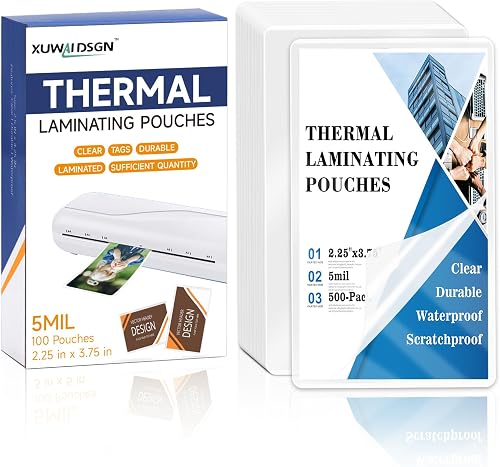
XUWAIDSGN 500 Pack 5mil 2.3x3.7in Thermal Laminating: Best for high-volume card size
- 500 pack, 5 mil
- 2.3 x 3.7 in
- Holds 2 x 3.5 in business card
- Thermal laminating pouch
Built for offices that laminate many cards, so count matters as much as clarity.
Pros
- 500 pack for large groups
- Fits 2 x 3.5 in cards
- 5 mil protection
Cons
- Thermal machine required
- Too small for larger badges
XUWAIDSGN 500 Pack suits a high-volume office that laminates cards every week. Its 500 count at 5 mil means you can reprint badges without reordering as often.
The pouch size is 2.3 x 3.7 in and fits a 2 x 3.5 in business card. That makes it a good fit for standard ID cards, name badges and business-card style credentials.
Leave a small border so the heat seal does not touch the printed area.
XUWAIDSGN says the recommended sealing temperature is 257 to 266 degrees Fahrenheit. Run one test card first and check both sides for clarity, because a setting that is too hot can distort a pouch and a setting that is too low can leave a weak seal.
Compared with the 200 pack 3 x 4 in pouch, this one is smaller and tighter. That is better for standard cards and worse for larger badges.
Compared with the CAREGY 500 count, the size and thickness are similar, so choose by which pouch size matches your card stock.
Buy it for large batches of standard cards. Skip it for larger government size cards or vertical badges.
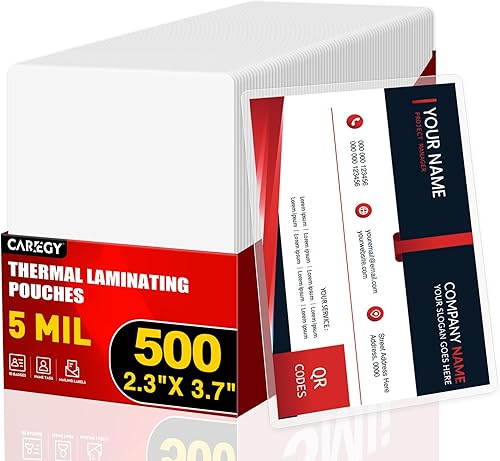
CAREGY 500 Count Thermal Laminating Pouches: Best for standard business card badges
- 500 count, 5 mil
- Holds 2 x 3.5 in
- 2.3 x 3.7 in
- Thermal laminator needed
A 5 mil, business-card fit for IDs, photo cards and name badges in bulk.
Pros
- 500 count for schools or offices
- Crystal clear gloss
- Fits 2 x 3.5 in items
Cons
- Not self-adhesive
- Thermal machine required
CAREGY suits offices that need a 5 mil pouch sized for business cards and photo cards. Its 500 count, 2.3 x 3.7 in pouch fits items up to 2 x 3.5 in.
CAREGY says the pouch uses a two-layer PET and EVA structure and is anti-stain and waterproof. In daily use, that means the badge resists surface moisture and scratches better than a plain paper card, while the gloss finish keeps text visible.
This pouch needs a thermal laminator and is not self-adhesive. That is the main trade-off against the Scotch option.
If you already own a laminator, the per-badge cost and finish will likely suit bulk work better.
Compared with the XUWAIDSGN 500 pack, this pick is a close match in size and thickness. The difference is mainly in which brand you trust for consistent seals.
Test a few pouches first, because consistent sealing across a 500 pack matters more than the first pouch looking good.
Buy it for bulk standard cards with a thermal laminator. Skip it if you want self-sealing use or a holed pouch.
XUWAIDSGN 100 Pieces 10 Mil 2 1/2: Best for rigid 10 mil protection
- 100 pieces, 10 mil
- 2 1/2 x 4 1/4 in
- Slot hole
- Thermal laminate pouch with loop
Extra-thick 10 mil pouches for badges that bend, rub and get handled daily.
Pros
- 10 mil rigid finish
- Slot hole fits lanyard or reel
- Loop included
Cons
- Stiffer feel than 5 mil
- Thermal machine required
XUWAIDSGN 10 Mil suits badges that get clipped, carried in a backpack or handled by many people. Its 10 mil thickness makes a rigid badge that resists bending better than 5 mil pouches.
The pouch measures 2 1/2 x 4 1/4 in and has a slot hole, so it works with a lanyard, badge clip, badge reel or ID holder without extra punching. A loop is included, which helps when you want a simple attachment.
XUWAIDSGN says the recommended sealing temperature is 257 to 266 degrees Fahrenheit. Thicker pouches need a laminator that can reach that setting and hold it steady.
If your laminator struggles with 10 mil, test one pouch before you commit to the pack.
Compared with 5 mil options, this badge feels more like a plastic card. That rigidity protects the paper inside, but it can feel bulky in a wallet or a tight holder.
For a work permit, event pass or student ID on a lanyard, the trade is often right.
Buy it for rigid, daily-handled badges on a lanyard. Skip it if your holder is flexible or your laminator is not rated for 10 mil.
HOUYEE 200 Pack 5Mil Thermal Laminating Pouches: Best for vertical ID badge size
- 200 pack, 5 mil
- 2.5 x 4.25 in
- With hole
- Holds up to 2.25 x 4 in cards
A vertical ID size with a hole, made for employee and student badges.
Pros
- Vertical badge fit
- Hole included
- Rounded corners
Cons
- Thermal machine required
- Narrower than 3 x 4 in pouches
HOUYEE suits vertical ID badges that need a hole and a pouch much taller than it is wide. Its 2.5 x 4.25 in pouch holds cards up to 2.25 x 4 in.
The 5 mil thickness gives sturdy protection without the stiffness of 10 mil. HOUYEE says the pouch withstands high temperatures and protects against bends and surface moisture.
That matches the daily wear pattern of an employee badge on a clip.
The hole is pre-cut and the corners are rounded, which helps the badge slide into a holder more easily. Rounded corners also reduce the chance of catching on clothing or a bag.
Compared with the GBC 5 mil pouch at 2-5/8 x 3-7/8 in, HOUYEE is taller and narrower. That shape fits vertical badges better.
Compared with the 3 x 4 in XUWAIDSGN pouch, it leaves less side room, so measure your card before you choose.
Buy it for vertical badges with a hole. Skip it if your card is wider than 2.25 in or if you need a clip included.
GBC Laminating Sheets: Best for crisp professional clarity
- 100 pack, 5 mil
- 2-5/8 x 3-7/8 in
- HeatSeal Ultra Clear
- Thermal laminating pouches
A known office brand pouch for ID sized documents that need a clean glossy look.
Pros
- Glossy clear finish
- 5 mil sturdy protection
- Fits ID sized documents
Cons
- 100 pack only
- Thermal machine required
GBC suits readers who want a known office brand for ID sized documents. Its 5 mil HeatSeal Ultra Clear pouch at 2-5/8 x 3-7/8 in gives a glossy, clear finish.
GBC says the pouches produce bright, durably protected documents with vivid clarity. In practical terms, the gloss helps text and color stand out, while 5 mil provides solid protection with limited flexibility.
This is a thermal pouch for use with any thermal laminator, including GBC models listed in the data. The laminator is sold separately, so confirm you own a compatible machine before ordering.
Compared with bulk 500 packs, this 100 pack is smaller, which suits a small office or a single department. Compared with 10 mil GBC pouches, it stays more flexible and is easier to fit in a standard holder.
Buy it for a clean, professional finish in a smaller pack. Skip it if you need a hole, a clip or a larger card size.
XUWAIDSGN 100 Pieces ID Laminating Pouches: Best for government size cards with clips
- 100 pieces with 100 clips
- 3 x 4 in
- Government size card
- With hole
Built around larger government size cards and a clip for each badge.
Pros
- Clips included
- Fits larger cards
- Hole for lanyard or reel
Cons
- Larger pouch for small cards
- Thermal machine required
XUWAIDSGN ID Laminating Pouches with Clips suits larger cards that need a clip ready to use. Its 3 x 4 in pouch fits government size cards and includes 100 clips.
The clips matter because not every badge holder uses a hole. With a clip included for each pouch, you can hand out a finished badge without a separate supply run.
The slot hole also works with a lanyard or reel if you prefer that attachment.
XUWAIDSGN says the recommended sealing temperature is 257 to 266 degrees Fahrenheit. As with other thermal pouches here, test one badge and inspect the seal and clarity before you laminate a full set.
Compared with the 200 pack 3 x 4 in pouch without clips, this option adds attachment hardware. Compared with smaller 2.3 x 3.7 in pouches, it leaves more room around a standard card, which can be good for border space and bad for a tight holder.
Buy it for larger cards when clips save you a separate purchase. Skip it if your cards are small or your holders already include clips.
GBC Swingline Laminating Sheets: Best for long-life rigid badges
- 100 pack, 10 mil
- 2-9/16 x 3-3/4 in
- HeatSeal LongLife
- UV coating
Rigid 10 mil pouches with UV protection for badges used every day.
Pros
- 10 mil rigid protection
- UV coating helps prevent fading
- Badge ID size
Cons
- Stiff for wallet use
- Thermal machine required
GBC Swingline suits badges that need long-life protection and a rigid feel. Its 10 mil HeatSeal LongLife pouch at 2-9/16 x 3-3/4 in creates a stiff, durable badge.
GBC says the pouches have a UV coating that helps prevent fading and discoloration. That matters for badges kept near windows, in vehicles or in bright work areas where paper prints can fade over time.
The 10 mil thickness protects against wear and tear and keeps the badge from bending in a pocket or bag. That rigidity is the main trade-off against 5 mil pouches, which flex more and fit more holders.
This is a thermal pouch compatible with listed GBC laminators, sold separately. Confirm your laminator handles 10 mil before you choose it, and test one pouch to check clarity on both sides.
Buy it for rigid, long-life badges used daily. Skip it if you need flexibility, a hole or a wallet-friendly badge.
How to choose laminating pouches for ID badges
The best choice is the pouch that fits your card with a clear border, matches your laminator and matches the holder you will use. Size first, then thickness, then attachment.
Start by measuring your card in inches and writing down the height and width. Add at least 1/4 in on each side for the seal.
A card that fills the pouch edge to edge will often have a weak seal or covered text.
What size pouch do I need for my badge?
Measure the card, then add border room. A 2 x 3.5 in card needs a pouch near 2.3 x 3.7 in, while a taller badge near 2.25 x 4 in needs a pouch near 2.5 x 4.25 in.
If you are between sizes, choose the larger pouch and center the card. Extra room is easier to manage than a pouch that is too small.
But check the holder, because extra pouch material can make the finished badge too wide.
Our best laminating pouches small roundup helps when your cards are compact or your holder is narrow. Our best laminating pouches index card size guide helps when your badge is closer to index card size than to a standard ID.
Should I pick 3 mil, 5 mil or 10 mil?
Pick 5 mil for most badges, 10 mil for rigid daily wear and 3 mil only for light protection. Thickness decides how much the badge bends in your hand and in a holder.
If you want to compare thinner options, our best laminating pouches 3 mil guide explains when 3 mil is enough. If you want maximum stiffness, our best laminating pouches 5 mil guide covers the middle ground that suits most ID badges.
A 10 mil badge can feel like a plastic card. That is useful for a lanyard badge, but it can be awkward in a wallet.
A 5 mil badge flexes a little, which helps it fit more holders.
Do I need a hole, a slot or a clip?
Choose a hole or slot when you use a lanyard, reel or clip. Choose a clip when you want to attach the badge without relying on a punched hole.
A pre-cut hole is safer than punching after sealing, because the seal stays intact. If your holder already clips to the badge, a plain pouch may be all you need.
Can I use self-sealing pouches instead of thermal pouches?
Yes, self-sealing pouches work well for a few badges and no machine. Thermal pouches usually give a thinner, more even finish for bulk work.
If you choose self-sealing, read our how to use scotch laminating pouches guide before you start. Center the card, smooth out air and press the seal firmly.
A test pouch helps you learn the pressure that works best.
How we compared these ID badge pouches
We compared the pouches by card fit, thickness, attachment options, count and machine needs. Each product was judged against the job of protecting an ID badge that stays readable and fits a holder.
Size came first because a pouch that does not fit the card cannot do the job. We checked the stated pouch size against the card size it holds, and we noted when a pouch is vertical, square or government size.
Thickness came next. We grouped the picks into 5 mil for daily wear and 10 mil for rigid protection, and we noted the one self-sealing option that needs no machine.
That split helps you match thickness to how the badge will be worn.
We also checked attachment features. Holes, slots and included clips decide whether a badge works with a lanyard, a reel or a holder.
Counts mattered too, because a 500 pack suits a school or office very differently from a 15 pouch self-sealing pack.
| Product | Best for | Size | Count | Type | Our score |
|---|---|---|---|---|---|
| Scotch Self-Sealing Laminating Pouches | no machine needed | 4.3 x 6.3 in | 15 | Self-sealing | 9.7 |
| XUWAIDSGN 200 Pack 5mil 3x4 Thermal Laminating | bulk thermal badges with holes | 2.94 x 4.13 in | 200 | 9.6 | |
| XUWAIDSGN 500 Pack 5mil 2.3x3.7in Thermal Laminating | high-volume card size | 2.25 x 3.75 in | 500 | 9.4 | |
| CAREGY 500 Count Thermal Laminating Pouches | standard business card badges | 2.3 x 3.7 in | 500 | 9.2 | |
| XUWAIDSGN 100 Pieces 10 Mil 2 1/2 | rigid 10 mil protection | 2.5 x 4.2 in | 100 | 9.0 | |
| HOUYEE 200 Pack 5Mil Thermal Laminating Pouches | vertical ID badge size | 2.5 x 4.25 in | 200 | 8.7 | |
| GBC Laminating Sheets | crisp professional clarity | 2-5/8 x 3-7/8 in | 100 | 8.5 | |
| XUWAIDSGN 100 Pieces ID Laminating Pouches | government size cards with clips | 3.1 x 3.9 in | 100 | 8.2 | |
| GBC Swingline Laminating Sheets | long-life rigid badges | 2.56 x 3.75 in | 100 | 8.0 |
How to laminate an ID badge cleanly
A clean badge starts with a clean card and a centered placement. Trim any rough paper edges first, then wipe the card if it has dust or oils.
Place the card in the pouch with an even border on all sides. Keep barcodes, QR codes and photos away from the seal area.
If the pouch has a hole, make sure the card does not cover the hole.
For thermal pouches, check your laminator setting against the pouch thickness. XUWAIDSGN lists 257 to 266 degrees Fahrenheit for several of its pouches, so use that range as a starting point and test one badge.
Feed the pouch straight, with the sealed edge feeding first when your laminator manual calls for it. Let the badge cool flat for a minute.
Warm pouches can warp if you bend them right away.
For self-sealing pouches, peel, center, press and smooth. Work from the center out to push air toward the edges.
If you see bubbles, lift and reapply while the adhesive is still workable.
Common mistakes with badge laminating pouches
The most common mistake is choosing a pouch by name instead of by inches. Badge, ID and card sizes overlap, so two pouches with similar names can fit very different cards.
Another mistake is sealing too close to the edge. A seal that touches a photo or barcode can hide information and weaken the bond.
Leave a border, even if it means choosing the next pouch size up.
A third mistake is using the wrong thickness for your laminator. A setting that works for 3 mil may not seal 10 mil well.
Test one pouch when you change thickness or brand.
Glare is also a real issue. Glossy pouches add shine, which can make a badge hard to read under bright lights.
If your badges are scanned or read under office lights, test one finished badge in that light before you laminate a batch.
Verdict: which badge pouch should you buy
The best laminating pouches for ID badges are the Scotch Self-Sealing Laminating Pouches if you have no laminator, and the XUWAIDSGN 200 Pack 5mil 3x4 if you laminate in bulk with holes. Those two picks cover the most common needs in this list.
Pick the XUWAIDSGN 500 Pack or CAREGY 500 Count when you need many standard cards and already own a thermal laminator. Pick the HOUYEE 200 Pack when your badge is vertical.
Pick the XUWAIDSGN clips pack when your card is government size and you want clips included.
Pick 10 mil, from XUWAIDSGN or GBC Swingline, when a badge must stay rigid on a lanyard or in daily handling. Pick 5 mil for most holders, because it protects well without feeling like a plastic card.
Measure your card, check your holder and confirm your laminator can handle the thickness. Then buy the pouch that fits all three, and test one badge before you laminate the rest.
For smaller cards, our best laminating pouches for business cards guide is a useful next step.
Our top 3 picks at a glance
-
1
-
2
Best for bulk thermal badges with holes
XUWAIDSGN 200 Pack 5mil 3x4 Thermal Laminating
9.6/10 our score
See it on Amazon -
3
Best for high-volume card size
XUWAIDSGN 500 Pack 5mil 2.3x3.7in Thermal Laminating
9.4/10 our score
See it on Amazon
Frequently asked questions
What size laminating pouch fits a standard ID badge?
Most standard ID badges fit a pouch about 2.5 x 4.25 in or 3 x 4 in, with the card at least 1/4 in smaller on each side. Measure your card first, then leave a clear border so the seal does not cover text or a photo.
Should I choose 3 mil, 5 mil or 10 mil for ID badges?
Choose 5 mil for most ID badges because it stays flexible in a holder and still resists bends and moisture. Choose 10 mil when a badge is clipped, worn daily or needs to stay rigid.
Choose 3 mil only for light protection where flexibility matters more.
Do ID badge pouches need holes or clips?
Holes help when you use a lanyard, badge reel or clip, and clips help when you do not want to punch the pouch. If your holder already has a clip, a plain pouch may be enough.
Match the pouch to the holder you will actually use.
Can I laminate an ID badge without a machine?
Yes, with self-sealing pouches such as the Scotch option here. You press the adhesive layers together by hand, so no heat or power is needed.
Thermal pouches give a thinner, more uniform seal but require a laminator.
How do I keep text readable after laminating?
Leave a border around the card, center it, and avoid sealing over barcodes or QR codes. Glossy pouches can add glare, so check your badge under office light.
Matte pouches are not in this list, so test one badge before laminating a batch.