How Much Does Printer Ink Cost?
Ink costs for printers depend on cartridge type, page yield, printer model, and how much ink each page uses. A cartridge with a higher upfront cost can cost less per printed page when it produces more usable pages.
On this page (8 sections)
- What makes ink costs for printers vary?
- How do you compare cartridge cost fairly?
- Which cartridge suits lower-volume printing?
- When does high-yield toner make sense?
- Is the highest-yield cartridge always the best value?
- What else changes the cost of printer supplies?
- How can you lower your printing cost?
- What is the best way to judge ink costs for printers?
Ink costs for printers depend on the cartridge type, printer model, page yield, and how much material each page uses. A low-cost cartridge can become expensive to use if it produces fewer pages, while a high-yield cartridge may reduce replacement frequency.
This guide focuses on the costs behind cartridges rather than a single price. The useful comparison is cost per usable page, not just the amount paid for one box.
That shift matters because two cartridges can look similar on a shelf yet behave very differently in daily use. A standard cartridge may suit a printer that handles a few forms each week, while a high-yield cartridge may suit a household or office that prints every day.
Page yield also needs context. It is an estimate from a standard test, so your own pages will vary with text, graphics, fonts, and print settings.
Printer type sets the basic system. Inkjet models use liquid ink, and laser models use toner, which helps explain why some cartridges are larger and why replacement intervals differ.
Model fit matters just as much as capacity. A cartridge made for one Brother printer will not necessarily fit another, even when both machines print black pages only.
Coverage is the quiet factor. Mostly text pages use less material than dark or image-heavy pages, so a cartridge can run out sooner in a busy office than in a quiet home.
For that reason, the best value is not always the cheapest box or the largest yield. It is the cartridge that fits your printer, matches your normal volume, and lets you use most of its capacity before the next replacement.
What makes ink costs for printers vary?
Cartridge yield is the biggest factor in ongoing printer supply costs. Yield is the estimated number of pages a cartridge can print under a standard test method, but your actual result changes with page coverage and print settings.
A mostly blank text page uses less material than a page filled with dark graphics. Draft mode, larger fonts, bold text, photos, and repeated cleaning cycles can all change how long a cartridge lasts.
Printer type matters too. Inkjet printers use liquid ink cartridges, while laser printers use toner cartridges.
If you are comparing the two systems, Do Laser Printers Use Ink or Toner? Explained explains the basic difference.
How do you compare cartridge cost fairly?
Compare the cartridge cost with its stated page yield. The simple calculation is cartridge cost divided by expected pages, although your real cost can be higher if you print heavily covered pages.
Also check whether the yield is standard or high yield. A standard cartridge may suit light printing because you aren't storing as much unused toner.
A high-yield cartridge can suit a busy home office that prints regularly.
The printer model is just as important as the cartridge type. A cartridge that fits one Brother printer may not fit another Brother printer, even when both are black-and-white laser models.
For a closer look at the other side of the comparison, read Why Does Toner Cost More Upfront Than Ink?. The higher initial cost can make sense when the cartridge produces substantially more pages.
What does page yield tell you about ink costs for printers?
Page yield tells you how many pages a cartridge is expected to produce under a defined test standard. It does not promise the same result for every household or office.
The Brother TN420 is rated for about 1,200 pages under ISO/IEC 19752 standards. That makes it a practical reference point for a standard-yield black toner cartridge.
The Brother TN660 is rated for up to 2,600 pages, and the Brother TN760 is rated for about 3,000 pages. Those higher yields can reduce how often you replace the cartridge, especially when your printer handles regular text documents.
Which cartridge suits lower-volume printing?
The Brother Genuine TN420 Mono Laser Toner Cartridge suits compatible Brother printers with a standard 1,200-page black toner requirement. It is a single genuine black cartridge designed for professional mono laser print quality.
The TN420 works with models including the Brother DCP-7060D, DCP-7065DN, HL-2220, HL-2230, HL-2240, HL-2240D, HL-2270DW, HL-2275DW, HL-2280DW, MFC-7240, MFC-7360N, MFC-7460DN, MFC-7860DW, FAX-2940, and related compatible models listed in its specifications.
Choose this type when your printer specifically requires TN420 and your printing volume does not justify a higher-yield cartridge. Check the exact model before ordering, because toner compatibility is model-specific.
When does high-yield toner make sense?
High-yield toner makes sense when you print often enough to use its larger page capacity. It can reduce replacement interruptions, but it may not be the best match for very occasional printing.
The Brother Genuine High Yield TN660 Toner Cartridge is rated for up to 2,600 pages. It is one genuine black cartridge for compatible Brother laser printers and all-in-ones.
The TN660 is compatible with models such as the Brother DCP-L2520DW, DCP-L2540DW, HL-L2300D, HL-L2305W, HL-L2315DW, HL-L2320D, HL-L2340DW, HL-L2360DW, HL-L2380DW, MFC-L2680W, MFC-L2685DW, MFC-L2700DW, MFC-L2705DW, MFC-L2707DW, MFC-L2720DW, and MFC-L2740DW.
Its high-yield design may suit a home office, small office, or household that prints frequent forms and text pages. The cartridge also supports Amazon Dash Replenishment when activated with an eligible Brother printer, which can help automate replacement ordering.
For more context on why some branded supplies cost more, see Why Is Epson Ink So Expensive?.
Is the highest-yield cartridge always the best value?
The highest-yield cartridge is not always the best value because your printer must support it and your print volume must use the extra capacity. A larger cartridge can be wasteful if you print only a few pages and replace supplies infrequently.
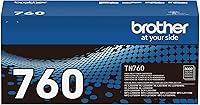
The Brother Genuine TN760 High Yield Black Toner Cartridge is rated for about 3,000 pages. It is a single black genuine cartridge for compatible Brother models including the MFC-L2710DW, MFC-L2750DW, HL-L2350DW, HL-L2370DW, HL-L2395DW, HL-L2390DW, and DCP-L2550DW.
Choose the TN760 when your printer model requires TN760 and you regularly print enough pages to use its capacity. Its pack size is 1, so it is easy to match to a single replacement cycle.
Do not choose it only because the page yield is higher. Confirm the printer model first, then compare the expected number of pages you print during the cartridge's useful period.
What else changes the cost of printer supplies?
Print coverage, color use, and maintenance can change your real supply cost. A black text document usually uses less material than a full-page image, while color printing uses multiple cartridges.
Inkjet users should also consider separate black and color replacements. If one color runs out, the printer may stop some jobs even when the other cartridges still contain ink.
Read Why Is Printer Ink So Expensive? for a broader look at cartridge design and replacement costs.
Laser printer users should check whether their printer uses a standard or high-yield toner cartridge. The guide to cost of laser printer toner cartridges can help you compare toner capacity and replacement patterns.
How can you lower your printing cost?
Print only what you need, use draft settings for internal documents, and choose a cartridge with a yield that matches your workload. Keep regular documents in black and white when color is not needed.
Avoid buying a cartridge based only on the lowest upfront cost. Compare the correct model, page yield, and your expected monthly pages.
A standard cartridge can suit light use, while high-yield toner can reduce interruptions for regular printing.
Store replacement cartridges in their original packaging until needed. Follow the printer's installation instructions, keep the cartridge area clean, and use the printer's normal maintenance controls rather than repeatedly cleaning it without a reason.
If you are deciding between an inkjet and a laser printer, Why Do Laser Printers Not Use Ink Cartridges? explains why laser supplies use toner instead.
What is the best way to judge ink costs for printers?
Pick the cartridge that matches your printer and print volume, then compare its expected cost per page. Choose the TN420 for a compatible standard-yield printer with lighter needs, the TN660 for compatible Brother models needing up to 2,600 pages, and the TN760 for compatible models needing about 3,000 pages.
The right page yield matters more than the largest number on the box. Verify the printer model, estimate your normal page coverage, and select a cartridge you can use before replacing it.
Start with the exact printer model. That check prevents a wrong purchase and gives you the correct cartridge type for your machine.
Then think about how you actually print. A home office with steady forms and documents may use a high-yield cartridge well, while a home printer used now and then may be better served by a standard cartridge.
Coverage should shape the decision too. Bold text, wide margins, and full-page graphics change how quickly toner is used, so heavy pages can shorten any cartridge life.
Keep the replacement in its packaging until needed, follow the printer guidance when you install it, and keep the cartridge area clean. Store spares in a cool, dry place and avoid unnecessary cleaning cycles.
Each choice has a trade-off. Standard yield keeps the replacement cycle smaller for light use.
High yield can reduce interruptions for regular printing, but only when your volume is high enough to use the extra pages.
That is why cost per page is the fairest test. Match the cartridge to your printer, match the yield to your habits, and you are more likely to get useful pages from every replacement.
Frequently asked questions
What affects ink costs for printers?
Ink costs for printers depend on the cartridge price, page yield, printer model, print coverage, and replacement schedule. A cartridge rated for more pages may lower your cost per page, but only if it fits your printer and your normal print volume uses that capacity before the toner or ink ages.
Is high-yield toner cheaper to use?
High-yield toner can be cheaper per page because one cartridge produces more pages. Compare the cartridge cost with its stated yield, then consider your printer model, print coverage, and whether you print often enough to use the extra capacity.
Why does printer ink seem expensive?
Printer ink can seem expensive because cartridges hold a small amount of consumable material and are tied to a specific printer model. Color printers also use separate cartridges, while page yield changes with text coverage, images, font size, and print settings.
Can toner cost less than ink?
Toner can cost less per printed page when a laser cartridge has a high page yield and your printer mainly produces text. The upfront cartridge cost may be higher, so compare usable page yield instead of judging the supply by its purchase price alone.