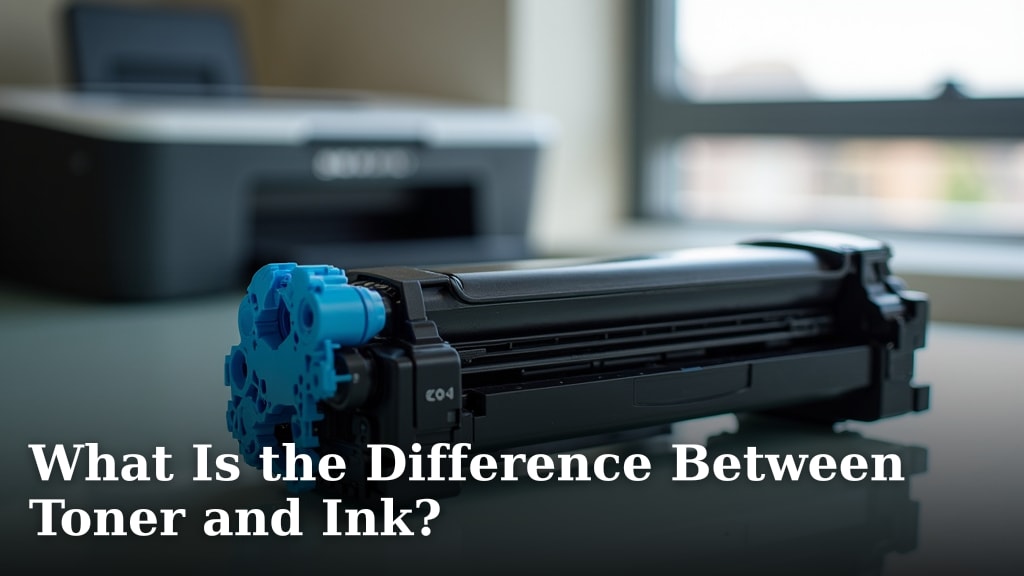
What Is the Difference Between Toner and Ink?
The main difference between toner and ink is their composition and how they are applied. Toner is a powder used in laser printers, while ink is a liquid used in inkjet printers. Laser printers use heat to fuse toner onto paper, creating sharp, durable text. Inkjet printers spray tiny droplets of liquid ink onto the paper for printing.
Understanding these differences helps you choose the right printer and cartridges for your needs. We found that each type has its own strengths, whether you’re printing documents or photos. For example, toner is often preferred for high-volume text printing due to its cost-effectiveness and smudge resistance. Ink is typically better for printing vibrant color images.
- Toner is a powder used in laser printers.
- Ink is a liquid used in inkjet printers.
- Laser printers fuse toner with heat.
- Inkjet printers spray liquid ink.
- Toner excels at sharp text and high volumes.
- Ink is better for colorful photos.
Let’s break down exactly what toner and ink are and how they work in your printer.
Understanding Printer Cartridges: Toner vs. Ink
Choosing the right printer often comes down to understanding its core components. Two of the most common printing technologies use either toner or ink. While both aim to put an image on paper, they work in very different ways. We found that knowing the basics of toner and ink can save you time and money. It helps you pick the best printer for your printing habits and ensure you buy the right cartridges when you need them.
What Exactly Is Toner?
Think of toner as a very fine powder. It’s made from plastic particles, carbon black, and sometimes colorants. This powder is held in a drum unit or cartridge inside a laser printer. When you print, the laser printer uses a charged drum to attract the toner particles. Then, it transfers this toner to the paper. A fuser unit heats the paper and toner, melting the plastic particles. This process fuses the toner permanently onto the page. We found that this powder is quite durable once applied.
The Makeup of Toner
The composition of toner is key to its performance. The fine powder is engineered to melt at specific temperatures. This ensures a smooth finish. It’s typically made from polyester or styrene acrylate. These polymers give it the ability to fuse. Color toners also contain pigments to create vibrant blues, reds, and yellows. When mixed, these can form a wide spectrum of colors.
How Toner Works in a Laser Printer
Laser printers are designed around toner. First, a laser beam “draws” the image or text onto a rotating drum. This creates an electrostatic image. The toner powder, which is also electrostatically charged, sticks to the charged areas of the drum. Next, the paper rolls past the drum. The toner transfers from the drum to the paper. Finally, the paper passes through heated rollers called the fuser. This melts the toner, pressing it into the paper fibers. Many experts say this process is why laser prints are often smudge-proof almost immediately (Heidelberg).
What Is Ink?
Ink, on the other hand, is a liquid. It’s used in inkjet printers. Ink cartridges hold liquid ink, usually in dye-based or pigment-based formulations. Inkjet printers work by spraying incredibly tiny droplets of ink onto the paper. These droplets then dry on the surface. We found that the way ink is applied makes it great for detailed images.
The Many Types of Ink
There are two main types of ink: dye-based and pigment-based. Dye-based inks use colorants that are dissolved in a liquid. They tend to produce very bright and vivid colors. However, they can be more susceptible to fading from UV light and moisture. Pigment-based inks use solid particles of colorant suspended in a liquid. These particles sit on top of the paper surface. They are generally more resistant to fading and water. Many sources suggest pigment inks are better for archival printing (Image Permanence Institute).
How Ink Works in an Inkjet Printer
Inkjet printers use a print head with tiny nozzles. These nozzles spray the liquid ink onto the paper in precise patterns. There are two common methods for spraying the ink: thermal and piezoelectric. Thermal inkjet printers heat the ink in a chamber, creating a bubble that forces a droplet out. Piezoelectric inkjet printers use a tiny crystal that flexes when an electric charge is applied, pushing the ink out. We found that the control over droplet size allows for high detail in prints.
Key Differences in Performance and Use
While both toner and ink get the job done, they excel in different areas. Your printing needs will determine which is the better fit for you. We’ve seen that for everyday documents, one might be more cost-effective, while for photo printing, the other shines.
Text Quality and Sharpness
Toner is king when it comes to printing sharp, crisp text. Because it’s a powder that fuses onto the page, it creates very defined edges. This makes small fonts and detailed text highly readable. Many users find that documents printed with toner look professionally produced. Laser printers are often preferred in office environments for this reason. We found that text printed with toner is less likely to smear, even right after printing.
Color and Image Printing
Inkjet printers, and therefore ink, are typically the go-to for printing photos and graphics. The ability of inkjet printers to spray tiny droplets allows for smooth color gradients and fine details. This means richer, more vibrant images compared to what most laser printers can produce. For home users who print photos or color-heavy presentations, inkjet printers are usually the better choice. We found that the color accuracy can be exceptional with the right ink and paper combination.
Speed and Volume
Laser printers using toner are generally faster than inkjet printers, especially for large print jobs. They can process pages more quickly because the fusing process is very efficient. If you need to print hundreds of pages regularly, a laser printer can save you a lot of time. Inkjet printers can be slower, especially when printing high-resolution images that require many tiny ink droplets. We found that for high-volume printing, laser printers often have a lower cost per page.
Durability and Longevity
Toner prints are known for their durability. Once fused, the toner is very resistant to smudging, water, and fading. This makes them ideal for important documents that need to last. Ink prints, particularly those made with dye-based inks, can be more delicate. They might fade over time or be damaged by moisture. Pigment-based inks offer better longevity but can still be less robust than fused toner. Many archival standards suggest pigment inks are suitable for long-term display (Image Permanence Institute).
Cost Considerations: Cartridges and Pages
When thinking about the ongoing costs of printing, the price of cartridges and the yield (how many pages you can print) are crucial. We’ve looked at the numbers, and there’s a clear difference.
Initial Purchase Price vs. Ongoing Costs
Inkjet printers often have a lower upfront cost than laser printers. However, the ink cartridges for inkjet printers can be expensive, and you might find yourself replacing them more frequently. Toner cartridges, while often more expensive initially, tend to print many more pages. This can make the cost per page lower for laser printers, especially for text-heavy documents.
Yield and Cost Per Page
Toner cartridges typically have a much higher page yield than ink cartridges. A standard black toner cartridge might print 1,000 to 3,000 pages or more. In contrast, a standard black ink cartridge might print 200 to 600 pages. When you divide the cost of the cartridge by the number of pages it yields, you often find that toner offers a lower cost per page. This is a major factor for users who print frequently. We found that for high-volume printing, the savings with toner can be substantial.
When to Choose Which: A Quick Checklist
To help you decide, consider these points:
- For crisp, smudge-proof text and high-volume document printing: Toner is usually your best bet.
- For vibrant, detailed color photos and graphics: Ink is generally superior.
- If printer cost is the main concern and you print rarely: An inkjet printer might be more budget-friendly initially.
- If you need fast printing for many pages: Laser printers with toner are often quicker.
- For archival quality prints that need to last decades: Look into pigment-based inks or toner.
- If your printer sits unused for long periods: Inkjet heads can dry out, so toner might be more reliable.
| Feature | Toner (Laser Printers) | Ink (Inkjet Printers) |
|---|---|---|
| Composition | Fine powder | Liquid |
| Application Method | Heat fusing | Spraying tiny droplets |
| Best For | Sharp text, high volume, durability | Vibrant color photos, detailed images |
| Print Speed | Generally faster | Can be slower, especially for photos |
| Cost Per Page | Often lower for high volume | Can be higher, especially for color |
| Smudge Resistance | Excellent | Varies; pigment ink is better than dye ink |
Conclusion
We’ve learned that toner and ink are fundamentally different, each serving distinct printing needs. Toner’s powder fuses with heat for sharp, durable text and high-volume jobs, often with a lower cost per page. Ink’s liquid droplets excel at vibrant photos and detailed graphics, though cartridges can be more frequent purchases. Your choice hinges on whether you prioritize crisp documents, stunning photos, speed, or budget. Consider your most common print tasks to pick the printer and supplies that work best for your home or office.
Frequently Asked Questions
Can I use toner in an inkjet printer, or ink in a laser printer?
No, you absolutely cannot. Toner is a dry powder used in laser printers, while ink is a liquid used in inkjet printers. Trying to use the wrong type of cartridge will damage your printer and will not produce any usable prints.
Which is cheaper to buy: a printer with toner or a printer with ink?
Typically, inkjet printers (which use ink) have a lower upfront purchase price. Laser printers (which use toner) often cost more to buy initially, but their toner cartridges can print many more pages, potentially making them cheaper in the long run for high-volume printing.
Do toner cartridges last longer than ink cartridges?
Yes, generally toner cartridges last much longer than ink cartridges. We found that toner cartridges are designed to print thousands of pages, while ink cartridges often print only a few hundred pages before needing replacement.
Is toner or ink better for printing photos?
Ink is usually better for printing photos. Inkjet printers can spray incredibly fine droplets of ink, allowing for smooth color gradients and fine details that create vibrant and realistic images. Toner is optimized for sharp text, not subtle color photo reproduction.
What happens if my inkjet printer sits unused for a long time?
If an inkjet printer sits unused, the liquid ink in the print head can dry out and clog the tiny nozzles. This can lead to poor print quality or even require expensive repairs. Laser printers using toner do not have this issue because the toner is a dry powder.